As the Friedman Brain Institute (FBI) Research Scholars Program celebrates its 10th anniversary, one recent milestone captures the program’s purpose in a single arc: an audacious idea, backed early by philanthropy, now advancing with $6 million in support from the National Institutes of Health (NIH).
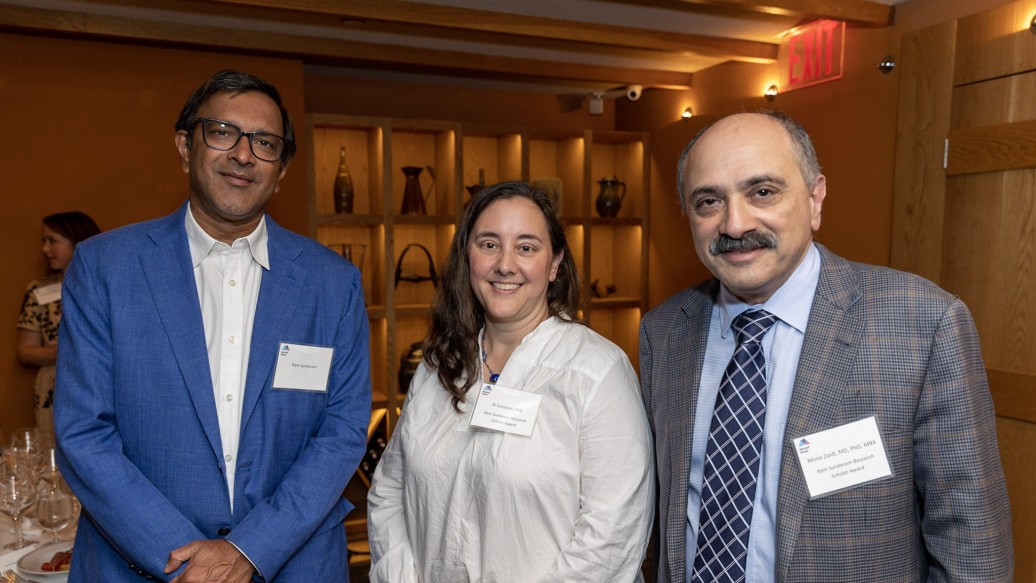
From left: Friedman Brain Institute Research Scholars Program Supporter Ram Sundaram; Ki A. Goosens, PhD; and Mone Zaidi, MD, PhD, MBA, at the 2023 FBI Research Scholars Dinner.
In 2023, Ram Sundaram and Preethi Krishna backed a Research Scholars project led by Ki A. Goosens, PhD, and Mone Zaidi, MD, PhD, MBA, through the Ram Sundaram and Preethi Krishna Research Scholar Award. Their seed gift supported a high-risk, high-reward hypothesis: that follicle-stimulating hormone (FSH)—best known for its role in fertility—may also help drive a set of serious, co-occurring conditions in people with Down syndrome, including bone frailty, obesity, and Alzheimer’s disease.
That “moonshot” mindset has long resonated with Sundaram, who has supported FBI Research Scholars from its inception. “The world needs more moonshot projects,” he says, pointing to the reality that big breakthroughs often start as uncertain bets. “You don’t even know where the application ultimately may be, and perhaps nothing happens with 95 percent of them. But that five percent could change the world.”
The Research Scholars Program is built for that moment—supporting innovative, collaborative pilot projects and giving investigators the freedom and flexibility to explore audacious ideas in brain science. For donors, it also offers something rare: genuine access to discovery as it unfolds. Sundaram describes the annual Scholars dinner as an experience he looks forward to because “you hear all these young people talk about their work and you leave feeling that you’ve learned something. That makes a huge difference in how you feel your support is making an impact. You feel like you’re part of something.”
Sundaram understands the logic of early bets. In his own career, he’s seen how a small “drop” can become something much larger. “You make small investments, and one or two end up becoming amazing opportunities,” he says. “The smallest thing can become the biggest part of what you have. It’s just how things work. Only this isn’t the next social media company—this actually has a profound impact on people’s lives.”
In this case, the early support mattered in a measurable way, with exponential returns. The seed-funding Sundaram provided helped position Drs. Goosens and Zaidi’s work for its next step: the $6 million Transformative Research Award through the NIH INCLUDE program and the Office of the NIH Director, an award mechanism specifically intended to recognize high-risk, high-reward research. This trajectory represents a perfect continuum for the FBI Research Scholars program.
The stakes are profound for patients and families. “Because most people with Down syndrome will develop Alzheimer’s disease dementia,” Dr. Goosens says, “approaches to treat Down syndrome-associated Alzheimer’s are urgently needed.” The new NIH award will support the team’s next phase: studying why FSH is elevated in Down syndrome, and testing whether reducing FSH signaling can lessen Alzheimer’s-like pathology and improve function in other organ systems.
“People with Down syndrome enrich our communities in countless ways. They also face a higher burden of certain medical conditions, including early-onset Alzheimer’s disease,” says Paul J. Kenny, PhD, Nash Family Professor and Chair of the Department of Neuroscience at the Icahn School of Medicine at Mount Sinai and Director of the Friedman Brain Institute. “This new research program led by Drs. Goosens and Zaidi will deepen our understanding of these health challenges and help catalyze the development of therapies that support healthier, longer, and more independent lives. We are deeply grateful to supporters like Ram and Preethi, whose philanthropy makes this kind of early, catalytic work possible.”
“Without the initial generosity of the FBI Scholars program donors, we would not have been able to explore our paradigm-shifting hypothesis,” Dr. Goosens adds.
Ten years into the FBI Research Scholars Program, this is what success looks like: donors excited to fund moonshots early, investigators given the flexibility to follow their imaginations, and a promising idea earning the scale of support needed to move closer to real-world impact. “Especially in our current environment,” reflects Sundaram, “the world needs more money for science, not less.”
Explore opportunities to make a profound and lasting impact at Mount Sinai and beyond.