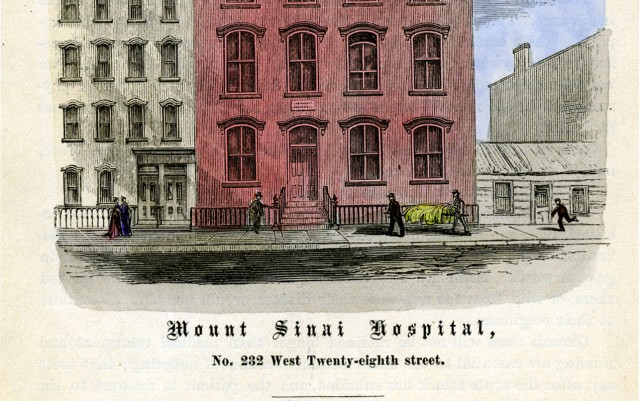
April 30, 2026, marked a significant milestone for the Sleep Medicine Research Program at the Icahn School of Medicine at Mount Sinai: The ribbon cutting for the program’s new space at 420 Lexington Avenue in Manhattan, which is now named for the program’s founder and Director, David M. Rapoport, MD. The establishment of the David M. Rapoport, MD Sleep and Respiratory Research Program at Mount Sinai, which is part of The Catherine and Henry J. Gaisman Division of Pulmonary, Critical Care and Sleep Medicine, is the culmination of the program’s success and growth under Dr. Rapoport’s leadership.
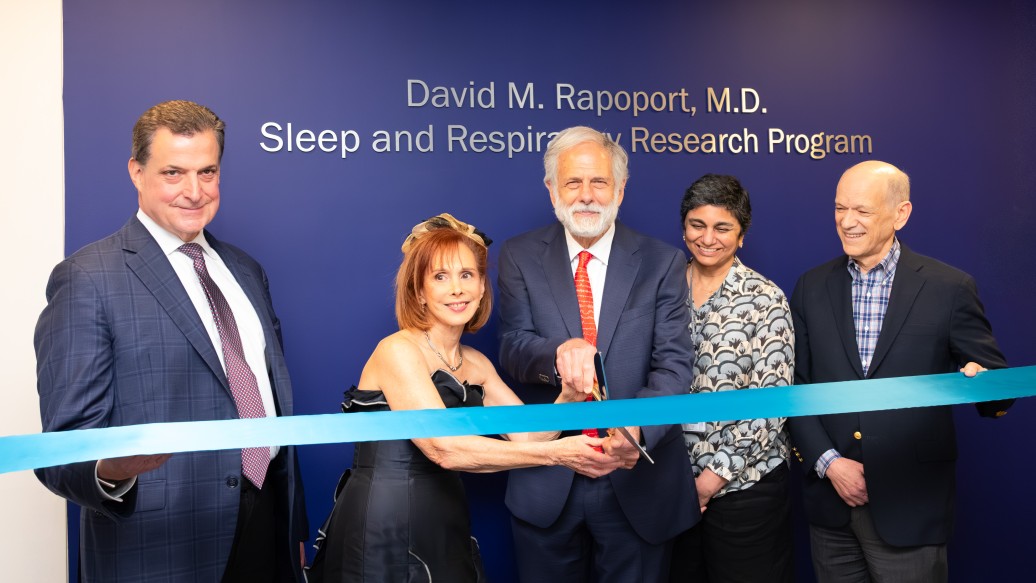
From Left: Charles A. Powell, MD, MBA, Chief, The Catherine and Henry J. Gaisman Division of Pulmonary, Critical Care and Sleep Medicine; Cheryl L. Kunis, MD, MS; David M. Rapoport, MD, Professor of Medicine, Pulmonary, Critical Care and Sleep Medicine and President of the Foundation for Research in Sleep Disorders; Indu A. Ayappa, PhD, Director, David M. Rapoport, MD Sleep and Respiratory Research Program and Professor of Medicine, Pulmonary, Critical Care and Sleep Medicine; and Eric J. Nestler, MD, PhD, the Anne and Joel Ehrenkranz Dean of the Icahn School and Executive Vice President and Chief Scientific Officer of the Mount Sinai Health System.
The naming of the program was made possible by current gifts and a bequest from Dr. Rapoport and his wife, Cheryl L. Kunis, MD, MS. Dr. Rapoport is a pioneer in the physiology of sleep-disordered breathing and one of the first physician-scientists to use a nasal continuous positive airway pressure (CPAP) machine to treat sleep apnea. Dr. Kunis is a clinical nephrologist and bioethicist.
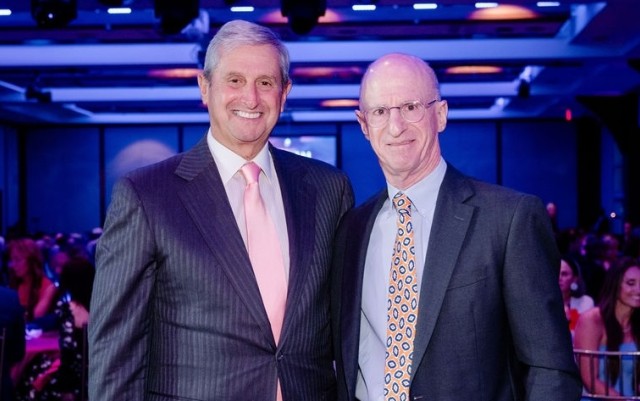
The guests who attended the ribbon cutting included Eric J. Nestler, MD, PhD, the Anne and Joel Ehrenkranz Dean of the Icahn School and Executive Vice President and Chief Scientific Officer of the Mount Sinai Health System; and Charles A. Powell, MD, MBA, System Division Chief, The Catherine and Henry J. Gaisman Division of Pulmonary, Critical Care and Sleep Medicine.
Also present was Dr. Rapoport’s longstanding mentor, Roberta M. Goldring, MD, Professor Emerita of Medicine at New York University’s Grossman School of Medicine, who continues to be active in pulmonary teaching and research.
A Legacy of Innovation
In the 1970s, as a fellow at NYU Medical Center/Bellevue, Dr. Rapoport had an interest in pulmonary physiology. His mentor, Dr. Goldring, had been studying patients who weren’t breathing adequately even though they were capable of doing so. She suggested that Dr. Rapoport investigate what happens while patients were asleep.
“I started recording these patients, and it was absolutely unbelievable,” Dr. Rapoport said. “It was like suddenly putting on glasses when you had been blind before. I saw all these things happening.”
Not long afterward, an Australian researcher named Colin Sullivan published a paper that demonstrated the remarkable effectiveness of CPAP, which he had invented. Dr. Rapoport immediately grasped the tremendous clinical and research possibilities CPAP offered.
“As I'm very fond of saying, this is probably one of the most effective treatments in all of medicine,” Dr. Rapoport said. “It makes insulin for diabetes and penicillin for pneumococcal pneumonia seem like crude treatments because it's an on-off switch for the problem. We then spent 20 years discovering that the clinical issue had moved from understanding how to treat the physiology to asking why patients don’t adhere to the therapy.”
“I had this incredible good fortune of being handed an unknown disease that turned out to be not only very frequent, but very important—and a way to treat it, which had been unheard of before—all in the first couple of years of my professional life. And, you know, you get passed that kind of a football, you run with it.”
Dr. Rapoport has always enjoyed creating and tinkering with gadgets. In 2020, at the dawn of the COVID-19 pandemic, he and Dr. Kunis were stuck in New Zealand. With his colleagues in New York City facing supply shortages, Dr. Rapoport remembered how he treated AIDS patients in the 1980s with mask ventilation therapy that was similar to CPAP. Recognizing the urgency of the moment, he worked via video with a team of doctors and respiratory therapists back at Mount Sinai and elsewhere to refashion donated BiPAP machines intended for sleep therapy into ventilators.
“He was losing sleep at night, saying to me, ‘Treating the sickest of these people with non-invasive ventilation may prevent some from dying of COVID,’” Dr. Kunis said. “He was very committed. That tells you the kind of person David is.”
A Devotion to Others
Several colleagues and friends of Dr. Rapoport addressed the guests at the ribbon-cutting event. Indu A. Ayappa, PhD, Professor of Medicine, Pulmonary, Critical Care and Sleep Medicine, was trained by Dr. Rapoport and has now worked alongside him for 30 years. She recently succeeded him as Director of the program.
“I, for one, get a genuine thrill walking into the lab and seeing David’s name on the wall, or from submitting a manuscript and writing that the work was performed at the David M. Rapoport Research Laboratory,” Dr. Ayappa said. “David, that means so much to us.”
A recurring theme among the speakers was Dr. Rapoport’s selflessness with his time and ideas. Andrew W. Varga, MD, another senior investigator in the Rapoport Lab, noted that one of his early research years was funded not by a National Institutes of Health grant, but by Dr. Rapoport’s foundation, the Foundation for Research in Sleep Disorders, which Dr. Rapoport financed from the proceeds of his numerous patents and other royalties over the years.
“There is a depth and breadth to David’s generosity that has really extended over many, many years,” Dr. Varga said. “This most recent gift is just the pinnacle of all of that.”
For his part, Dr. Rapoport told the guests his interest—and his reason for making the gift—was in seeing the program continue to flourish and be independent of any one individual. He later described his motivation as hopeful, rather than altruistic.
“One of the things that gives me the greatest pleasure is seeing other people succeed in the environment that we've created,” Dr. Rapoport said. “And so in a sense, it's very selfish to see other people succeed—it's a little bit like having a child and wanting them to do better than you've done. That's not altruism; that's just recognizing what pleases you the most.”
Learn how you can create a lasting legacy by including Mount Sinai in your will, trust, or retirement account. Contact Nora Nasif Rahaim in our Planned Giving Office at 347-491-2887 or nora.rahaim [at] mountsinai.org (nora[dot]rahaim[at]mountsinai[dot]org) to explore options that align with your vision.