For patients and families facing pancreatic cancer, there are few promising treatments. Pancreatic tumors are especially difficult to treat and often resist therapies that work against other cancers. Pancreatic tumors create a formidable defense, surrounding themselves with dense scar tissue and immune cells that suppress the body’s natural response. Immune cells struggle to reach the cancer, and treatments that succeed against other tumors often fall short. A new gift from Len and Emily Blavatnik and the Blavatnik Family Foundation will help Mount Sinai researchers explore new treatment approaches.

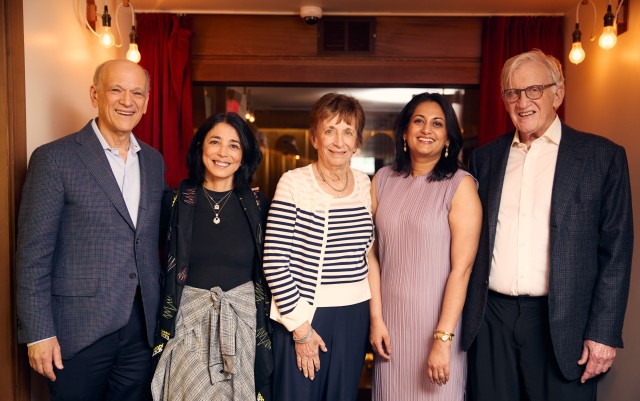
Pictured above (l-r): Miriam Merad, MD, PhD; Leona Kim-Schluger, MD; and Brian Brown, PhD.
The Foundation’s $1 million commitment supports Leona Kim-Schluger, MD, Associate Director of the Recanati/Miller Transplantation Institute at Mount Sinai, for innovative pancreatic cancer research. Dr. Kim-Schluger is sharing the gift with Miriam Merad, MD, PhD, and Brian Brown, PhD, providing early support to investigate how the immune system might be prompted to recognize and destroy pancreatic tumors.
Dr. Kim-Schluger, who is the Sydney J. Zweig Professor of Medicine, has brought together experts from across Mount Sinai to find a way through the tumors’ defenses. The team is studying how pancreatic tumors evade immune attack and testing several possible ways to intervene. These include breaking down fibrotic barriers, reprogramming suppressive immune cells, and developing new immunotherapies and mRNA-based technologies.
The work will also draw on Mount Sinai’s Neoadjuvant Research Group to Evaluate Therapeutics, which allows scientists and clinicians to observe how a patient’s tumor and immune system respond to treatment in real time. Those insights can accelerate learning and help translate discoveries from the lab into new therapeutic strategies.
The intention is for this work to bring to pancreatic cancer some of the immunotherapy advances that have changed care for other cancers.
"I have had the pleasure of knowing Emily Blavatnik over the past few years and am grateful for her partnership in continuing to make ambitious research possible across Mount Sinai," said Dr. Kim-Schluger. "In this instance, connecting the Foundation to my colleagues and their promising research in pancreatic cancer has been very rewarding."
"We are at a point where the science is giving us new ways to think about pancreatic cancer," said Miriam Merad, MD, PhD, Dean for Translational Research and Therapeutic Innovation, Chair of the Department of Immunology and Immunotherapy, and Director of the Marc and Jennifer Lipschultz Precision Immunology Institute at Mount Sinai (PrIISM). "We are learning much more about how these tumors shut down the immune response and, just as important, where they may be vulnerable. This gift gives us the freedom to follow the most promising leads and test them quickly."
That kind of flexibility matters. Promising early research often does not fit within traditional funding channels, particularly before investigators have enough evidence to support a larger study. This gift will give the team a chance to test ideas, learn quickly, and move the strongest approaches toward clinical trials.
"Some of the most important questions in science begin with an idea that is not yet ready for a conventional grant," said Brian Brown, PhD, Vice Chair of the Department of Immunology and Immunotherapy, Director of the Icahn Genomics Institute, and Associate Director of PrIISM. "This funding gives us room to take thoughtful risks, bring new technologies into the lab, and see what works. If we can establish proof of concept, we can begin moving a new strategy toward patients."
Lady Emily Blavatnik expressed the urgency of this work: "Patients with pancreatic cancer need more options. Mount Sinai brings together the scientific expertise, technology, and clinical insight needed to turn ideas into therapies. We are proud to support that work.”
The gift deepens a longstanding Mount Sinai partnership defined by Len and Emily Blavatnik’s commitment to advancing bold ideas and addressing medicine’s hardest questions.
Over the years, the Foundation has contributed more than $1.5 billion to advance scientific discovery, nurture future leaders, strengthen arts and cultural institutions, preserve Jewish history, and support organizations serving marginalized communities. The Blavatnik Family Foundation has often supported early-stage research, pursuing questions that might otherwise go unexplored, while also taking promising research forward.
The family’s relationship with Mount Sinai includes support for several areas of research and care. In 2018, a $10 million gift established the Blavatnik Family Women’s Health Research Institute and the Blavatnik Family-Chelsea Medical Center at Mount Sinai. The Foundation has also supported Mount Sinai’s Ovarian Cancer Translational Research Program and the Cancer Care Facility for Women.
In 2022, their son Val Blavatnik, inspired by the work of Michael Palese, MD, made a $1 million gift to expand the Milton and Carroll Petrie Department of Urology and establish the Men’s Health Center at Mount Sinai-Union Square. And in 2024, the Foundation committed $5 million to support Dr. Kim-Schluger’s work in developing organ perfusion technologies intended to dramatically increase the availability of organs for transplantation.
There is still much to learn. By giving researchers the freedom to pursue bold ideas, the Foundation is helping Mount Sinai develop treatments that patients need.
The Blavatnik family’s support has already led to the identification of a promising therapeutic target for enhancing pancreatic cancer immunotherapy response as published in Nature.
ABOUT THE BLAVATNIK FAMILY FOUNDATION
The Blavatnik Family Foundation provides many of the world’s best researchers, scientists and future leaders with the support and funding needed to solve humankind’s greatest challenges. Led by Len Blavatnik, founder of Access Industries, the Foundation advances and promotes innovation, discovery and creativity to benefit the whole of society. To date, the Foundation has contributed over $1.5 billion to more than 300 organizations. See more at blavatnikfoundation.org
ABOUT THE RECANATI/MILLER TRANSPLANTATION INSTITUTE AT MOUNT SINAI
The Recanati/Miller Transplantation Institute at Mount Sinai is one of the largest and most comprehensive adult and pediatric abdominal transplantation centers in the world. We are committed to outstanding patient care, research, and educational programs. Our transplant services for adults and children include kidney, liver, pancreas, and intestinal organ transplant.
Our distinguished team of surgeons, physicians, and other healthcare professionals support patients in need of a transplant every step of the way. Our multidisciplinary approach ensures that patients benefit from the expertise of multiple specialists who understand their unique needs.
Having performed more than 5,500 liver, kidney, pancreas, and intestinal transplants over 40 years, we have a rich history of innovation and excellence in the field of organ transplantation. One of the key factors in our success is close collaboration between our physicians and the scientists who conduct state-of-the-art research here. It enables us to provide leading-edge technologies and the most up-to-date therapies to our patients, including individuals with complex medical needs.