
From their earliest days, Mount Sinai and Goldman Sachs were shaped by a common understanding: that institutions do not exist apart from their communities, but are responsible to them. Both were founded in 19th‑century New York, forged by immigrants, animated by a sense of civic duty, and sustained over generations by individuals who believed that professional success carries with it an obligation to serve the public good.
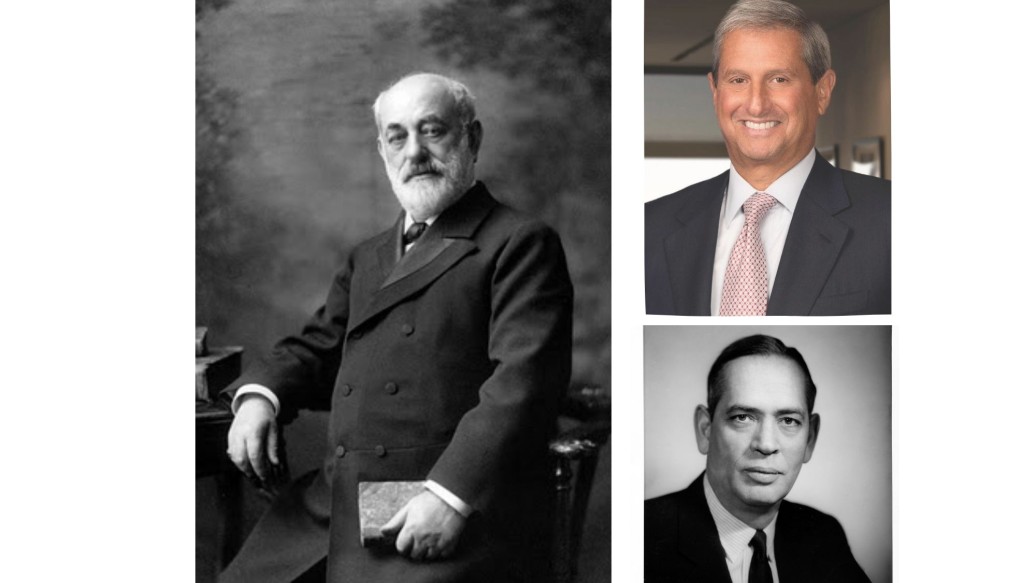
Marcus Goldman; Richard A. Friedman; Gustave L. Levy
Mount Sinai’s origins trace back to 1852, when nine members of New York’s Jewish community incorporated The Jews’ Hospital to provide care for those with nowhere else to turn. In 1869, Marcus Goldman founded a small financial firm built on trust, partnership, and long‑term thinking. Though distinct in purpose, both institutions emerged from the same city, the same era, and the same ethic: that excellence and compassion are not competing values, but complementary ones.
Over time, the relationship between Mount Sinai and Goldman Sachs evolved not simply through philanthropy, but through people—individuals whose leadership bridged both institutions and left a lasting imprint on each.
As early as the 19th century, figures connected to Goldman Sachs were already shaping Mount Sinai’s governance. Members of the Fatman and Sachs families served on Mount Sinai’s Board of Trustees across multiple generations, helping guide the hospital during periods of growth and transformation. Marcus Goldman’s son, Henry Goldman, served as secretary of Mount Sinai’s Board in the late 1800s, reflecting an early intertwining of leadership and service that would become a defining feature of the relationship.
The Sachs family’s influence extended well beyond governance; they were fundamental in cementing Mount Sinai’s reputation as a center of medical innovation, with discoveries that would resonate far beyond New York. Dr. Bernard Sachs, brother of Samuel Sachs, was a student of leading neuropsychiatrists, including Sigmund Freud, and was regarded as one of the country’s leading clinical neurologists. He was appointed as a consultative neurologist at Mount Sinai in 1893 and established Mount Sinai’s Department of Neurology in 1900: a 20-bed facility that was the first in a New York City general hospital. Dr. Sachs’s research led to the discovery of the pediatric disease to which he lends his name: Tay-Sachs Disease, while philanthropic support from Samuel and Harry Sachs funded early X‑ray technology, advanced research in pathology, and established the Joseph and Sophia Sachs Memorial Wards, named for their parents.
Few individuals embody the depth of this shared legacy more powerfully than Gustave L. Levy, Senior Partner of Goldman Sachs and one of the most consequential leaders in Mount Sinai’s history. Serving on Mount Sinai’s Board of Trustees from 1960 to 1976—and as Board President for much of that period—Mr. Levy presided over an era of extraordinary institutional change. Under his leadership, Mount Sinai launched a landmark fundraising effort to establish the Mount Sinai School of Medicine, oversaw the construction of major academic and clinical facilities, and reimagined the institution’s future as an integrated academic medical center.
The stock exchange closed at 3:30, and Gus departed shortly thereafter. By 4 most afternoons he was on the subway heading uptown to Mount Sinai Hospital to convene a meeting of its staff for the next two hours in his role as chairman of the hospital, the medical center and the school of medicine. He ran Goldman Sachs and Mount Sinai, both huge, complex business enterprises, for many years, seemingly unaware each was a full-time job.”
from Goldman Sachs: The Culture of Success by Lisa Endlich
Mr. Levy’s commitment was not symbolic; it was deeply personal. His life reflected a belief that leadership is not divided between professional and civic spheres—it is expressed through both.
That philosophy endured as a new generation of Goldman Sachs leaders joined Mount Sinai’s Boards of Trustees in the late 20th and early 21st centuries, bringing with them expertise in finance, governance, global affairs, and human capital. Their service coincided with Mount Sinai’s continued expansion, including the creation of the Mount Sinai Health System and the rapid growth of world‑class research and clinical enterprises.
In 2010, Richard A. Friedman, Chairman of Goldman Sachs Asset Management, and his wife Susan, made a transformational $20 million gift to establish the Friedman Brain Institute. The FBI, as it is known, has since become renowned as one of the world’s premier centers for neuroscience. Mr. Friedman’s leadership extended beyond personal philanthropy: from 2019 to 2026, he served as Co‑Chairman of Mount Sinai’s Boards of Trustees, alongside Loews CEO James S. Tisch, and served as Campaign Chair of Mount Sinai’s $2.3 billion Limitless Campaign, driving one of the most ambitious fundraising efforts in academic medicine.
There’s a rich relationship between the Goldman Sachs leadership and Mount Sinai—a feeling on both sides that we’re connected and that we’re family. When I joined the Mount Sinai Boards of Trustees, I felt I was a little bit of a torchbearer in going through this journey, and as co-chair, following in the early footsteps of Gus Levy.
Richard A. Friedman, Chairman Emeritus, Boards of Trustees, Mount Sinai Health System
John B. Hess, the long‑tenured CEO of Hess Corporation, was appointed as an independent director to the Goldman Sachs Board of Directors in 2024. As a Mount Sinai Trustee since 1988, Mr. Hess has played a defining role in transforming Mount Sinai’s research enterprise through the creation of the Leon and Norma Hess Center for Science and Medicine, named in tribute to his parents. The Hess Center accelerated recruitment of top scientific talent, expanded research capacity, and enabled discoveries to move rapidly from bench to bedside—signaling a decisive institutional commitment to translational research. Mr. Hess has also advanced Mount Sinai’s global health efforts through support of the Arnhold Institute for Global Health, including transformative work in Guyana. In March 2026, Mr. Hess was elected Chairman of the Mount Sinai Health System Boards of Trustees, continuing a lineage of overlapping Mount Sinai and Goldman Sachs leadership that stretches back more than a century.
What emerges from this history is not a series of transactional relationships or unconnected individuals, but an enduring alliance—one rooted in shared values, sustained by individuals of vision, and reinforced by a belief that institutions thrive when they invest in the communities they serve. For more than a century and a half, Mount Sinai and Goldman Sachs have walked parallel paths, intersecting again and again through leadership, philanthropy, and purpose.
Together, they tell a story of New York at its best: ambitious, humane, and committed to improving lives—generation after generation.
Champions of Philanthropy: Read more about our Trustee leadership
Explore our deeply-rooted connection to the Jewish community


