As an early supporter of the Carolyn Rowan Center for Women’s Health and Wellness, the Carte Blanche Foundation shares our vision for advancing women’s health through innovation, education, and compassionate care. In the guest essay that follows, the Foundation reflects on the purpose behind its support and the promise of investing in better care for women at every stage of life.
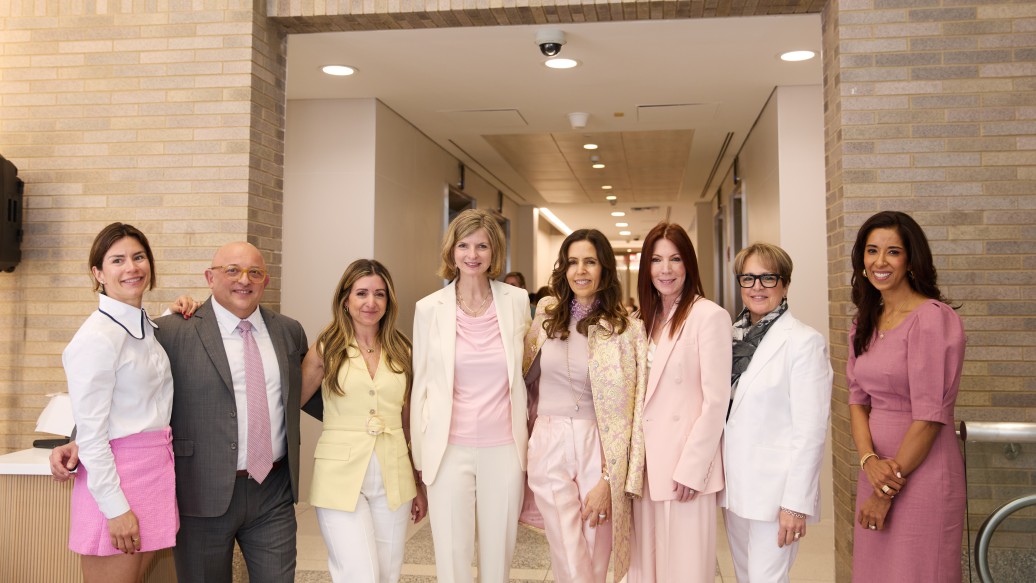
Members of the Carolyn Rowan Center for Women's Health and Wellness leadership team with Carolyn Rowan (fourth from right) at the Center's opening in May.
Guest Perspective: The Carte Blanche Foundation
When we went looking for a partner in women's health, something surprised us. There are many organizations, and many good ones, helping women with family planning, pregnancy, and birth. But almost none that meaningfully include a woman after birth and into midlife. The support simply falls away at the exact point when her health gets more complex.
The Challenge
Midlife is the stage of a woman's life that medicine forgot, and it's the one the Rowan Center chose to start with.
Every woman who lives into midlife will experience menopause. It affects the brain, the heart, the bones, sleep, mood, and metabolism. And yet fewer than one in five OB/GYNs report any formal training in it.
That is not a failure of individual doctors; menopause care has simply been missing from medical education for decades, at every level of the system.
And if women with excellent insurance and access struggle to find informed care, what chance does a woman in a poorer community stand, or one without health insurance? The Carolyn Rowan Center at Mount Sinai was built to close that gap, and we wanted to be there from the beginning.
The Solution
A new model of women’s health care that evolves across a woman’s lifetime.
The Center
The Rowan Center opened its doors in 2026 at Mount Sinai's Upper East Side campus, bringing primary and specialty care, mental health, integrative medicine, and reproductive health for women under one roof. Its clinical strategy is shaped by Dr. Anna Barbieri, one of the country's most respected voices in midlife women's health, and the Center treats menopause and midlife care as serious medicine rather than an afterthought. It is the first center of its kind in New York City, and Carte Blanche is proud to be among its earliest supporters.
The Model
What makes the Center different is not just what's under the roof but how it works together. A woman's cardiologist can speak with her gynecologist. Her pelvic floor therapist can walk down the hall to her urogynecologist. Her nutritionist and endocrinologist work from the same plan, and mental health is woven through all of it. When we visited the Center this spring to meet with Dr. Barbieri and Dr. Stone, we saw that this collaboration is literally built into the space: the facility is intentionally designed so clinicians cross paths throughout the day, with central gathering areas where teams come together to talk through patient care.
And the design elevates the experience on both sides of the relationship. Clinicians give better, smoother care because they are genuinely connected to the other clinicians caring for the same woman. A woman no longer travels all over the city with weeks between specialist appointments; her clinicians are right down the hall from one another. Care improves because the experience of giving it and receiving it improves together.
Evolving Care
Through the guided care pathways the Center calls MyPath, each woman moves through coordinated care built around her whole life rather than a stack of disconnected referrals. The Center's first pathway, MyPath Balance 40+, is designed for the midlife transition: a six-month personalized care experience supporting women through hormonal and metabolic health, heart and bone health, sleep, mood, pelvic health, and nutrition. As Dr. Barbieri puts it, every clinician a woman meets is "part of a connected team that already knows them, their goals, and their plan."
The Gap
The Center is solving many problems at once, but the one where we felt we could help is education.
A global review of medical textbooks found that more than half contained no mention of menopause at all. Fewer than 7 percent of primary care clinicians feel prepared to treat menopausal women, even as millions of women move through midlife right now. This is not a gap in caring. It is a gap in training, and no model of care, however beautifully designed, works without clinicians who know what to do. We are excited to support the Center as a whole, but for us, education is the ground floor: it is where everything else gets built.
Our 2026 grant supports the Rowan Center's Training and Education Fund for Women's Health
The Fund puts clinicians through Menopause Society certification, sends them to conferences to learn the latest evidence-based practices, and supports the annual Women's Health Symposium where that learning is shared across disciplines.
Here is why training is the investment we believe in. By the Center's projections, a single trained primary care provider reaches roughly 350 women ages 40 to 60 in their practice. A single Rowan Center specialist reaches roughly 500.
The ten clinicians being trained and certified through The Menopause Society this year, five primary care providers and five specialists, will directly improve care for approximately 4,250 women. And they join a remarkably small group: there are only about 1,300 certified menopause clinicians in the entire country.
This grant grows that number. Every clinician who learns this medicine carries it into every patient relationship they will ever have, and the care multiplies from there. That is the future we are betting on: a world where expert midlife care is not a privilege of geography or insurance status.
Learn more about the Carolyn Rowan Center for Women's Health and Wellness